
JIMBU Guide
Corporate Uniform Fabric Durability Standards: Compare Your Options
Compare corporate uniform fabric durability standards for cotton, polyester and blends, and learn which tests help you choose uniforms that last well.
The heaviest fabric isn’t always the most durable. Corporate uniform fabric durability standards should look beyond weight to how fabric performs through washing, daily wear and movement.
It’s easy to focus on cotton versus polyester, but the blend, weave, finish and working conditions also affect performance. A fabric suited to an office may not hold up in a role involving frequent washing or physical work.
This guide compares cotton, polyester, poly-cotton blends and industrial fabrics for durability, comfort and everyday wear. It also explains which tests and fabric details can help assess lasting performance, and how to match fabric to your team’s work and uniform needs.
Key Takeaways
- Choose fabric for the job, not by weight alone. Blend, weave, finish, and care all affect how it wears.
- Compare cotton, polyester, poly-cotton, and wool by comfort, shrinkage, laundering needs, and durability.
- Use fabric weight as a starting point, then consider embroidery, washing, and the demands of the work.
- JIMBU’s workforce options can help you apply this fabric advice when choosing uniforms for your team and supporting ongoing uniform needs.
How to choose the best fabric for a corporate uniform?
Match fabric to the work, washing routine, comfort needs and branding. Cotton, polyester, wool and blends each perform differently.
Poly-Cotton Specifications and Shrinkage
A 65/35 poly-cotton blend contains 65% polyester and 35% cotton. It balances polyester’s resistance to wear with cotton’s softer feel. The blend’s shrinkage matters after repeated industrial laundering. A 65/35 polyester-cotton fabric shrinks less than 1% through repeated industrial laundering. Compare this performance with the garment’s care routine, not the fibre label alone.
Poly-Cotton Composition and Durability
More polyester can improve colour and shape retention, while cotton adds breathability and comfort. A 65/35 blend is a practical option for uniforms that need regular washing and a polished appearance. Fabric weight, weave tightness, yarn strength, and finishing also affect durability. A heavier fabric isn’t automatically tougher, so weigh those factors alongside the blend composition.
Cotton, Polyester, and Blended Fabrics
Cotton feels soft and breathable, but can wrinkle, shrink, and fade more than polyester. Polyester resists wrinkles, dries quickly, and holds colour, though 100% polyester can feel warm during long wear. Poly-cotton balances these qualities. Wool can suit tailored corporate clothing, with lasting wear when properly cared for. For outdoor roles, consider breathability and the demands of the work.
| Fabric | Comfort | Durability consideration |
|---|---|---|
| Cotton | Breathable | May shrink and wrinkle |
| Polyester | Can feel warm | Holds colour and shape |
| Poly-cotton | Balanced feel | Composition affects performance |
| Wool | Suitable for tailored wear | Needs proper care |
Weigh comfort, laundering and the work environment together when choosing fabric.
Durability Standards and Fabric Costs
There isn’t one fabric specification that suits every uniform. Compare abrasion and pilling results, plus shrinkage after washing. ISO 12947-2:2016 covers the Martindale abrasion test, while ISO 12945-2:2020 covers pilling. In South Africa, an Eskom specification’s requirements are in accordance with SANS 724, according to Eskom.
Fabric costs depend on composition, weight, weave, finishing and branding requirements. A more complex finish or heavier fabric can affect the overall specification. Choose test results that reflect your laundering conditions and daily wear.
How to Evaluate and Select Industrial Uniform Fabrics?
GSM measures fabric weight per square metre. Use it as a starting point, then match the weight and test results to the garment’s purpose. Corporate uniform fabric durability standards should reflect the work, washing routine and finished garment.
Fabric Weight and GSM by Application
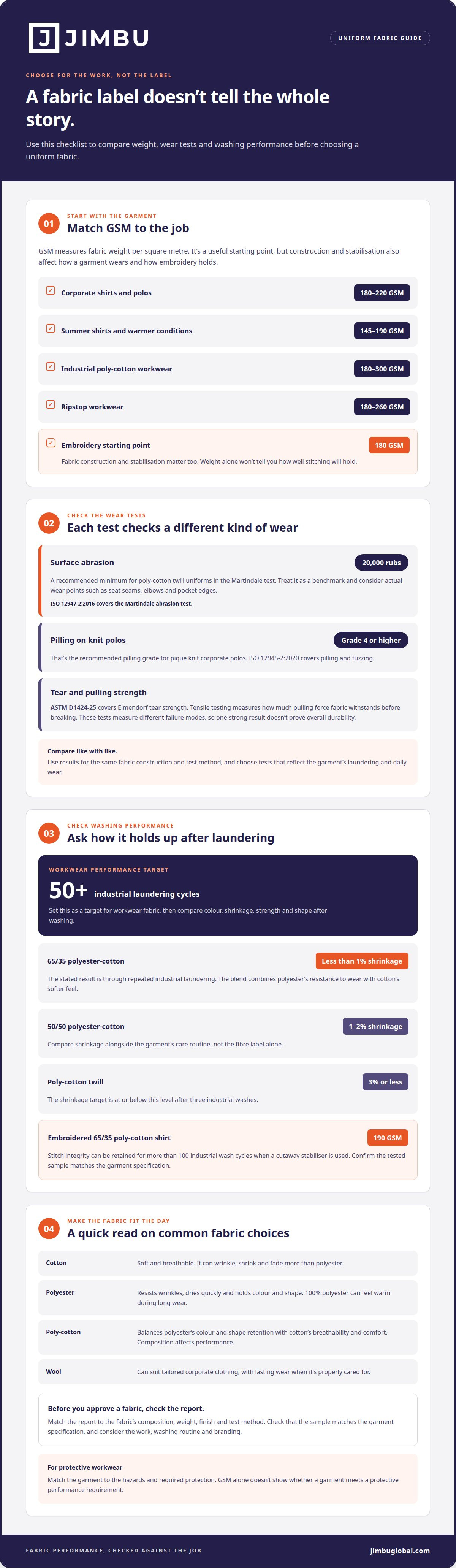
Corporate shirts and polos commonly use 180-220 GSM. Summer shirts and warmer conditions suit lighter fabrics around 145-190 GSM. Industrial poly-cotton workwear ranges from 180-300 GSM, while ripstop workwear ranges from 180-260 GSM. For embroidery, start at 180 GSM. Fabric construction and stabilisation also affect how well stitching holds, so weight alone isn’t enough.
Martindale Abrasion Ratings
The Martindale test measures surface abrasion. For poly-cotton twill uniforms, a recommended minimum is 20,000 rubs. That’s a useful benchmark, not separate ratings for office, hospitality, and industrial garments. Select a result that reflects actual wear points, such as seat seams, elbows, or pocket edges.
In South Africa, protective workwear needs to suit the hazards and required protection. GSM alone does not show whether a garment meets a protective performance requirement.
Uniform Fabric Strength Tests
ISO 12947-2:2016 covers the Martindale abrasion test. ASTM D1424-25 covers Elmendorf tear strength. Tensile testing measures how much pulling force fabric withstands before breaking. These tests measure different failure modes. Compare results for the same fabric construction and test method, rather than treating one strong result as proof of overall durability.
Verifying Test Reports and Supplier Claims
For corporate uniform fabric durability standards, match each report to the fabric’s composition, weight, finish, and test method. Then compare results with the garment’s intended use. Embroidery on a 65/35 poly-cotton shirt at 190 GSM can retain stitch integrity for more than 100 industrial wash cycles when a cutaway stabiliser is used. Confirm the sample matches the garment specification.
Is polyester or cotton better for office uniforms?
Polyester, cotton, and poly-cotton each suit different office conditions. For frequent industrial laundering, workwear fabric should survive at least 50 industrial laundering cycles.
Polyester, Cotton, and Poly-Cotton Durability
Polyester holds colour and shape through repeated washing, and resists wrinkles. Cotton offers softness and breathability, but can shrink, wrinkle, and fade more. A poly-cotton blend balances those qualities. For example, 65/35 polyester-cotton fabric shrinks less than 1% through repeated industrial laundering, while 50/50 fabric shrinks by 1-2%. Those differences can help maintain a uniform’s appearance between replacements.
Cotton Quality, Pilling, and Laundering
Cotton’s comfort depends on more than its fibre name. Fabric construction and weight affect how it wears, while repeated washing can contribute to shrinkage and fading. For pique knit corporate polos, a pilling grade of 4 or higher is recommended. ISO 12945-2:2020 covers pilling and fuzzing. Use the test result to compare surface appearance, and follow the garment’s care instructions to support its wear life.
Industrial Wash Cycle Requirements
Set a performance target of at least 50 industrial laundering cycles for workwear fabric. Then compare colour, shrinkage, strength, and shape after washing. Poly-cotton twill should have shrinkage at or below 3% after three industrial washes. Cotton breathes well, which can improve comfort in warm environments. It also chars rather than melts, unlike polyester, a relevant distinction in flash-fire or arc-flash environments. Choose fabric for the work and hazards, not appearance alone.
Fabric choice and uniform durability
Uniform choices should start with the job, not a fabric label. Hospitality staff moving between service areas need comfort and flexibility. Industrial workwear faces strain at seams, knees and elbows. Match fabric construction, stretch and finish to employees’ regular movements. Corporate uniform fabric durability standards should reflect the toughest tasks garments face during a normal shift, not just their intended appearance.
Washing affects apparel over time. Colour can fade, fabric can shrink, and seams or embroidery can lose their shape. Workwear performance can be assessed after industrial washing using EN ISO 15797 (2018), according to the European Union. Compare results after washing with the care process garments will receive. Unwashed fabric alone can’t show how a uniform will look after repeated use.
Branding adds another durability consideration. Embroidery puts tension on its backing and the surrounding fabric. A wear trial with active employees can reveal fit, comfort, seam wear and logo changes during real shifts. Include garments for different roles and sizes. Corporate uniform fabric durability standards should assess the finished item, since a durable fabric sample won’t reveal every issue with stitching or placement.
Set clear pass criteria before comparing samples. Record colour retention, shrinkage, pilling, seam condition and stretch recovery after washing. A uniform, for example, may retain its colour but restrict movement during lifting or reaching. That’s a poor fit for the role, even if the fabric performs well in one test. Review each result against the garment’s actual use.
Choose for the toughest regular conditions, then assess comfort and care needs across the team. This keeps fabric decisions tied to wear life, employees’ movements and consistent branding.
Corporate uniform fabric should withstand repeated washing without losing strength, colour or shape. Requirements vary by work environment and include texture, breathability, durability and ease of care. Set priorities when selecting fabric, such as durability versus cost and comfort versus fit.
For most corporate uniform programs, 65/35 polyester-cotton fabric at 180-210 GSM is recommended. Fabric below 160 GSM loses structure after repeated washing and begins to look worn before the replacement cycle. Poplin is lightweight and crisp, suits business blouses and dress shirts, and is easy to iron.
JIMBU: Uniform programmes for large workforces (just-in-time, stockholding, 1-hour delivery)
JIMBU’s uniform programmes are a practical next step when a large workforce needs coordinated uniforms. The programme includes just-in-time supply, stockholding, and 1-hour delivery. Each option suits a different type of need, from planned uniform issues to situations where a replacement is needed quickly.
Just-in-time supply may suit a team with uniform requirements that follow a schedule. It lets you plan supply around upcoming issues rather than treating every requirement as an immediate purchase. A clear outline of the garments, roles and timing helps keep the programme focused on workforce needs.
Stockholding may help when your operation needs selected uniform items available for ongoing replacement or regular distribution. Decide which garments are central to the programme and where consistent choices matter most. This can suit larger teams with recurring uniform needs better than a one-off clothing request.
For an urgent uniform need, JIMBU’s 1-hour delivery option may help address the timing. It’s part of the large-workforce uniform programme, alongside just-in-time supply and stockholding. Consider which needs are planned and which are time-sensitive, then choose the approach that best fits each one. These options support uniform programmes, not standalone courier requirements.
To start a useful conversation, bring together the types of garments your teams need, the roles they serve, and how you want to manage replacement supply. JIMBU can discuss Company Uniforms & Apparel and the programme options with you. Contact JIMBU if you’d like to talk it through.
Got questions?
Frequently Asked Questions
Ready when you are
Let's build something worth talking about.
One partner. End-to-end execution. From the first sketch to the last shipped box.