
JIMBU Guide
How to Import Promotional Products from China Safely
Importing promotional products from China? Get practical tips for artwork approvals, quality checks, freight timing and South African customs paperwork.
Your logo shouldn’t be the thing that gets lost in translation. Importing promotional products from China can work well for the right campaign, but it takes careful coordination of artwork, samples, production and freight. A strong idea deserves more than crossed fingers and a box that arrives too late.
Protecting your brand starts with clear artwork approvals and agreed product specifications. These help keep finished goods true to your design, while checks during production can catch quality issues before shipment.
Here, we’ll walk through protecting your artwork, checking samples and production, planning freight around your campaign date, and understanding the import paperwork for South Africa. You’ll also get a straight answer on when importing makes sense, and when a smaller order may be better sourced another way. Sharp, practical steps. No mystery-box approach.
Key Takeaways
- Work backwards from your campaign date, allowing room for production, sample changes and freight.
- Protect your artwork with clear approvals and keep the agreed design and product details together.
- Match quality checks to the product, then organise the paperwork needed for South African customs clearance.
- Weigh the order size, repeat demand and product finish before deciding whether importing is worth it.
Plan production and freight around your campaign date
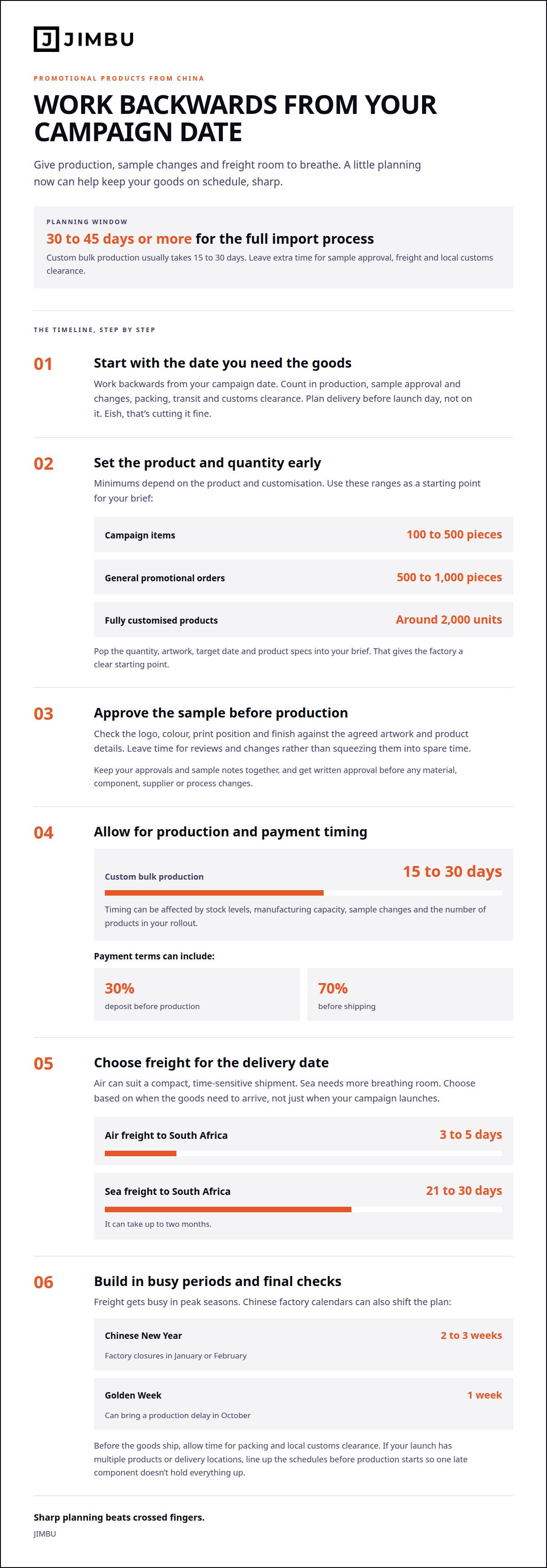
Got a campaign date? Work backwards from there, allowing time for production, sample approval and freight. Custom bulk production usually takes 15 to 30 days, and giving yourself 30 to 45 days or more leaves room for the full import process.
Minimums depend on the product and customisation. Campaign items can range from 100 to 500 pieces, general promotional orders from 500 to 1,000, and fully customised products around 2,000 units. Payment terms can include a 30% deposit before production and 70% before shipping.
Production times and minimum order quantities
Minimum orders vary by product. A simple branded item and a custom product made around your artwork can have different production needs. Pop the quantity, artwork, target date and product specs into your brief. That gives the factory a clear starting point and helps flag any design or quantity choices that could affect the timing.
Leave time for sample reviews and changes. Don’t count on fitting them into spare time. Include stock levels and manufacturing capacity in your sourcing plan, too. If your campaign has a few products, line up their production schedules so one late component doesn’t hold up the whole rollout.
Air and sea freight options and timeframes
Air freight can reach South Africa in 3 to 5 days, which can come in handy when the campaign date’s close or the shipment is compact and time-sensitive. Sea freight typically takes 21 to 30 days to South Africa, but can take up to two months. It’s a better fit when your schedule has a bit more breathing room.
Choose freight based on when you need the goods delivered, not just the campaign launch date. Allow time for production, packing, transit and local customs clearance. Freight can get busy during peak seasons, so don’t plan for your shipment to arrive on the day your event starts. Eish, that’s cutting it fine.
Chinese factory calendars matter, too. Chinese New Year closures can last 2 to 3 weeks in January or February, while Golden Week can bring a one-week production delay in October. Work backwards from your event and leave room for sample changes and busy freight periods. If your launch includes a few delivery locations, plan for them before production starts, not when the cartons are ready to go.
Category-specific product testing and quality checks
A logo can look sharp on screen and still arrive wonky on the product. Use the approved sample, artwork, materials and finish as your guide during production. Then check the things that matter for how you’ll use the item.
When you’re choosing a supplier, look at references, client feedback, whether the product suits your needs and how well they communicate. Check that their certifications and way of working fit your order, and ask how they’ll handle changes to quantities or requirements.
What you check depends on the product. For bags, look at the stitching, zippers and buckle plating. If sunglasses claim UV protection, ask for test evidence. For food contact items, approval or migration testing depends on the destination market, material and intended use.
Keep product variations clear. Colour, size, finish, plug type, language and set combinations can all affect a production run. A test report might cover only one model or a specific range, so check it matches the exact item being made. For toys, age grading affects small parts rules, testing scope and certification.
Before production starts, approve the sample’s logo, colour, print position and finish. Get written approval before anyone changes a material, component, supplier or process. That way, you’re less likely to get an unapproved substitute that changes the product you signed off.
Plan checks during production and before dispatch. Write down the approved quantity, carton labels, packaging condition and sample functionality. Approve the retail, inner and export packaging together, then test a unit and a loaded shipping carton. You might spot damage risks before the freight gets going.
Good communication makes quality checks easier. Keep approved artwork, sample notes and change decisions together in one written record. For a product built around your design, custom product development from China can bring sourcing and checks into the same process. Sharp approvals now can save a messy delivery later.
Import paperwork and customs
Bringing goods in from China? Get the product details and paperwork sorted before they ship. First, find the HS code and check which documents you’ll need. Then pull the import file together, ship the goods, and arrange customs clearance and delivery.
Getting your import documents ready
Start with a commercial invoice, packaging list, HS codes, certificate of origin and any permits you need. The HS code matters because it’s used to work out import duties for each product. Tax and VAT can differ by product too, so don’t lump every promo item under one description.
Keep product reports, certificates and approved references together in a file for each model. For consumer electronics, approval applies to a specific model, not the whole factory. Match the file to the exact item, including its components and model details, and keep the approved sample and artwork with the product record.
Getting through customs
Before the goods ship, check that the invoice, packing list and product descriptions match what you ordered. Include the right HS code for each product, plus a certificate of origin and any permits you need. When the paperwork lines up, customs can see what’s in the shipment and what each item is.
Once the goods arrive, you or your agent can arrange clearance using the shipping and product documents. According to South African Revenue Service, importers or their agents have seven days to clear landed goods, with 14 days for loose or break-bulk cargo and 28 days for goods in a container depot. Keep those deadlines in mind when planning delivery.
Import duties on goods coming into South Africa can range from 0% to 45%, depending on the products. The HS code affects the duty, and tax and VAT can vary by product. Factor those product-specific charges into the full order cost.
If a shipment has different models or variants, keep their references and supporting documents separate. That way, it’s easier to match each record to the right goods during customs clearance. A bit of tidy paperwork now can save a last-minute scramble.
When importing promotional products from China makes sense
A cheap factory quote can look lekker, but it doesn’t tell you what the order will really cost. Compare the full project cost with the value the products will bring to your campaign. For a very small order, importing from China might not be worth the hassle once production, freight and import requirements are included.
Importing can make more sense for repeat campaigns, a range of products or higher-value promo gear. Factory pricing and finishing might leave room for margin when you’re using the same range across several campaigns. With a one-off order and a short window to hand things out, there’s less chance to spread planning and setup costs across future campaigns.
Look past the product price, boet. Factor in testing or certification, tooling and print setup, retail packaging, inventory across variants, breakage, returns and spare-part support where it applies. A product with several colours, sizes or components can get complicated. Weigh that against how you’ll use it in the campaign and what the finished item’s worth to you.
Before manufacturing starts, keep the approved design, sample, materials and packaging details together. For repeat orders, save these references so the next run follows the version you agreed on. Handy for ranges with multiple items or finishes.
To make the call, confirm the quantity and campaign schedule, work out the full landed cost, then weigh the product’s quality and finish against what the campaign needs. If you’re up against a tight deadline, ordering a small quantity or changing the design often, importing might add more hassle than value. If the product’s part of repeat campaigns or a carefully planned range, sourcing from China could be a better fit.
Yip, it’s about the whole plan, not one tempting quote. If you’re weighing up a China project, shape your product import brief around your campaign, quantity and the finish you’re after.
JIMBU: Promotional Products
Got an idea for branded merch? We can help you develop custom products sourced from China, from the first product chat through to finished merchandise. Tell us about your campaign, artwork and what you need, and we’ll work it through with you.
Want to make it part of a bigger campaign? Our Promo in a Box and QR-code gamified campaigns can bring your products and the experience around them together. Send us your brief and we’ll help find products that fit your brand and what you’re trying to do.
Share your idea, intended quantity, campaign date and artwork with us. We’ll chat about the next steps, from choosing a product direction to development, and help you work out a practical plan.
Shout if you’d like to chat about your promotional product project.
Get your import plan moving
Turn a promising product idea into a clear campaign brief. Decide what the product should do for your audience, how it should represent your brand and where it fits in your wider activity. This gives your team a useful starting point for importing promotional products from China.
JIMBU also offers branded products, company uniforms and apparel, and brand stores. These can bring imported promotional products together with the rest of your branded gear. Keep your brief focused on the product, audience and campaign purpose, then chat with JIMBU about what to do next.
Ready to get the conversation started? Contact JIMBU about your import plans. Bring the idea as it stands, even if a few details are still taking shape. We’ll take it from there. Shout if you need a hand.
Got questions?
Frequently Asked Questions
Ready when you are
Let's build something worth talking about.
One partner. End-to-end execution. From the first sketch to the last shipped box.